Human-robot coproduction

Company

TU Delft

Role

PhD Candidate

Year

2013 - 2019

In 2013, small and medium-sized manufacturers wanted to use collaborative robots in their production but had almost no practical tools for designing those systems in the early phases. I took the challenge to address that gap by joining an EU-funded project which involved industrial and academic partners across Europe. Through field studies, laboratory experiments, and case studies with industrial partners I developed a methodology and toolset for designing human-robot production systems.
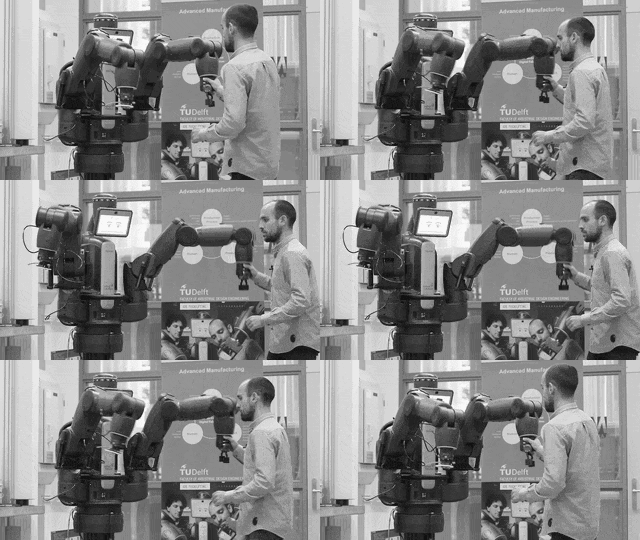
Context

TU Delft's Faculty of Industrial Design Engineering conducts applied research at the intersection of design, technology, and human behaviour. The PhD project I executed was part of the EU-funded Factory-in-a-Day programme, aimed at making collaborative robot technology accessible to small and medium-sized manufacturers.

Challenge

In 2013, collaborative robot technology was starting to slowly make it's way into small-scale production environments. Yet, engineers designing these systems had almost no accessible tools for the early planning stages for planning and outlining the production process that involved humans and collaborative robots. Available simulation and modelling tools were either too abstract or too complex for the exploratory phase where many critical decisions were made, leaving most early design work improvised and undocumented. This rendered the collaborative robots often useless for most small-scale operations.
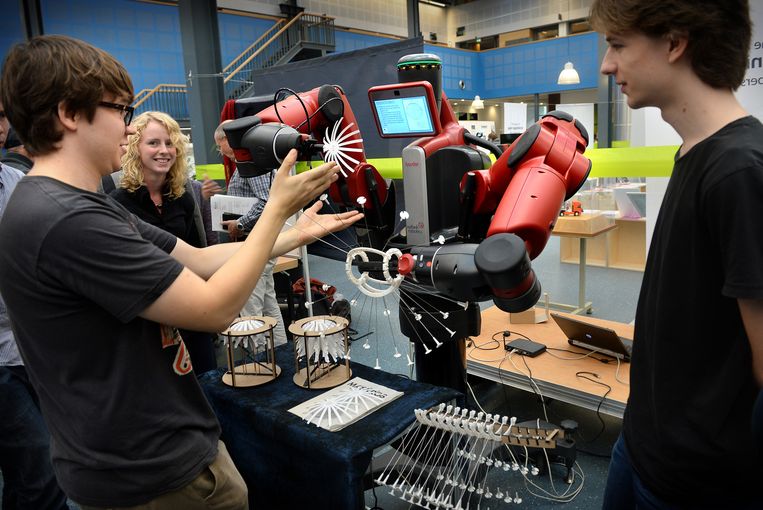
Contribution

I led my part of the research project from start to finish, managing the full scope from research questions through to validated outputs.

  • Built and ran multiple experimental production setups combining robots, 3D printers, and human operators under realistic conditions to test how different task allocations and interaction patterns performed in practice.

  • Developed a canvas-based design tool that gave engineering teams a practical way to model and compare human-robot production scenarios in early-stage design, before detailed modelling was warranted.

  • Managed collaboration with industrial partners including Philips, Randstad, and Universal Robots, and with academic partners across Europe, while coaching and supervising MSc and BSc students throughout.

I led my part of the research project from start to finish, managing the full scope from research questions through to validated outputs.

  • Built and ran multiple experimental production setups combining robots, 3D printers, and human operators under realistic conditions to test how different task allocations and interaction patterns performed in practice.

  • Developed a canvas-based design tool that gave engineering teams a practical way to model and compare human-robot production scenarios in early-stage design, before detailed modelling was warranted.

  • Managed collaboration with industrial partners including Philips, Randstad, and Universal Robots, and with academic partners across Europe, while coaching and supervising MSc and BSc students throughout.

I led my part of the research project from start to finish, managing the full scope from research questions through to validated outputs.

  • Built and ran multiple experimental production setups combining robots, 3D printers, and human operators under realistic conditions to test how different task allocations and interaction patterns performed in practice.

  • Developed a canvas-based design tool that gave engineering teams a practical way to model and compare human-robot production scenarios in early-stage design, before detailed modelling was warranted.

  • Managed collaboration with industrial partners including Philips, Randstad, and Universal Robots, and with academic partners across Europe, while coaching and supervising MSc and BSc students throughout.

Outcome

A completed PhD thesis, a validated methodology and toolset for early-stage human-robot production system design, one journal article and several articles in conference proceedings.